
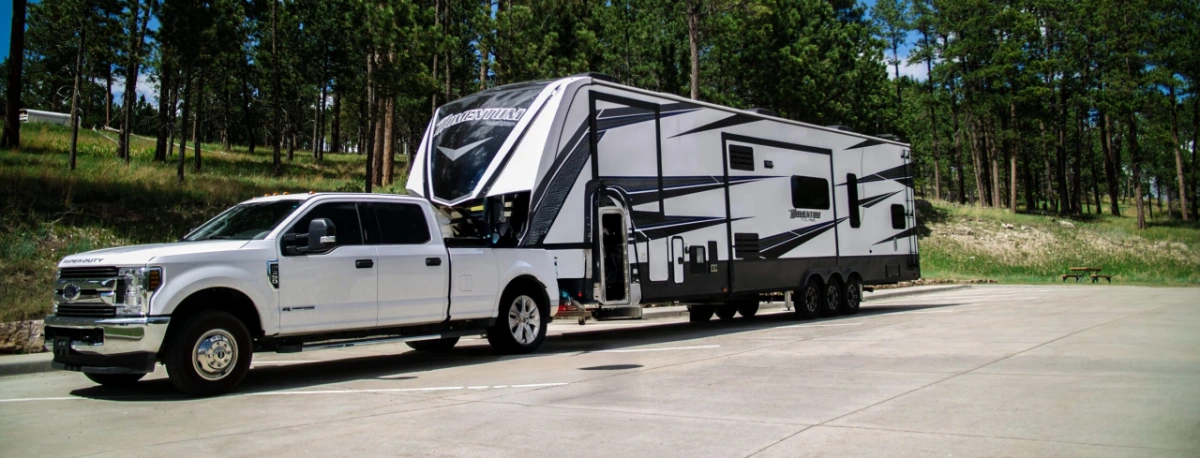
Most RVs sold in North America start their lives within a short drive of our office. Northern Indiana, centered on Elkhart County, builds the large majority of them. Every one of those units has to get from the end of a production line to a dealer lot somewhere else, and that move is its own discipline.
RV transport doesn’t work like moving cars. The units are bigger, heavier, and more varied, and a single dealer order can include three different kinds of equipment. Here’s how it actually works and where it tends to go wrong.
Three ways an RV moves
Towaway: for towables. Travel trailers, fifth wheels, and toy haulers don’t have engines, so a qualified driver hooks the unit to a properly rated pickup and tows it to its destination. This is how the bulk of towable inventory leaves the factory. It’s fast, flexible, and needs no loading equipment, but it depends entirely on the driver. Backing a 40-foot fifth wheel into a tight dealer lot is a skill, not a formality.
Driveaway: for motorhomes. Class A, B, and C motorhomes move under their own power, with a driver behind the wheel. Like any driveaway move, it’s usually the most direct option for a single unit. It also puts miles on the odometer, which matters on a new unit, and exposes it to weather and road conditions the whole way.
Flatbed or deck: for everything else. Damaged units, units that won’t start, and anything with dimensions or value that rule out towing or driving go on a deck. This is also the answer for some long-distance moves where mileage or wear has to stay at zero.
A typical dealer order mixes all three. A partner who can only do one of them means splitting the order across multiple providers, multiple schedules, and multiple sets of paperwork.
Where RV deliveries go wrong
Driver qualification. The most common problem is also the most preventable. Towing a large fifth wheel or driving a 40-foot Class A takes real experience, and the combined weight on a towaway move can cross commercial licensing thresholds. A driver who is legally qualified and practically comfortable with that unit class is the difference between a clean delivery and a damage claim.
Condition at handoff. RVs are full of components that can shift, loosen, or break in transit: slide-outs, awnings, cabinetry, roof equipment. Without condition reporting and photos at pickup and delivery, a damage dispute becomes your word against the carrier’s.
Dealer readiness. A driver arrives and the dealer has no room, no one to sign, or no idea the unit was coming. Now you’re paying for wait time or a second trip. A confirmed delivery appointment and a named contact at the dealership solve most of this.
Seasonal surges. RV volume isn’t steady. Dealers stock up ahead of the spring selling season, and model-year changeovers push a lot of inventory through the pipeline at once. Capacity that’s easy to find in a slow month can disappear in a busy one.
What RV makers and dealers should require
- Drivers matched to the unit class, with towing or motorhome experience verified, not assumed
- Equipment coverage across towaway, driveaway, and deck moves, coordinated as one order
- Condition reports with photos at pickup and delivery, built to your PDI process
- Delivery appointments confirmed with the dealer before the unit leaves
- Capacity that holds in peak season, not just in the slow months
- One point of contact for the whole order, including someone who manages the claims process for you if something goes wrong
| Ask any RV transport company one question: how do you confirm a driver is qualified for this specific unit? The answer tells you most of what you need to know. |
Why location matters
Fox Fleet Logistics is based in Wakarusa, in the heart of RV country. We know the plants, the lanes out of Elkhart County, and the seasonal rhythm of this industry because we see it every day.
We coordinate RV transport across towaway, driveaway, and flatbed through a vetted carrier and driver network, with direct access to asset-based sister companies when brokered capacity gets tight. One point of contact handles the order from the factory to the dealer, and we manage the claims process for you.
If you’re shipping RVs, tell us about your lanes and volume. If you’re a qualified RV driver or towaway carrier, we’d like to hear from you too.